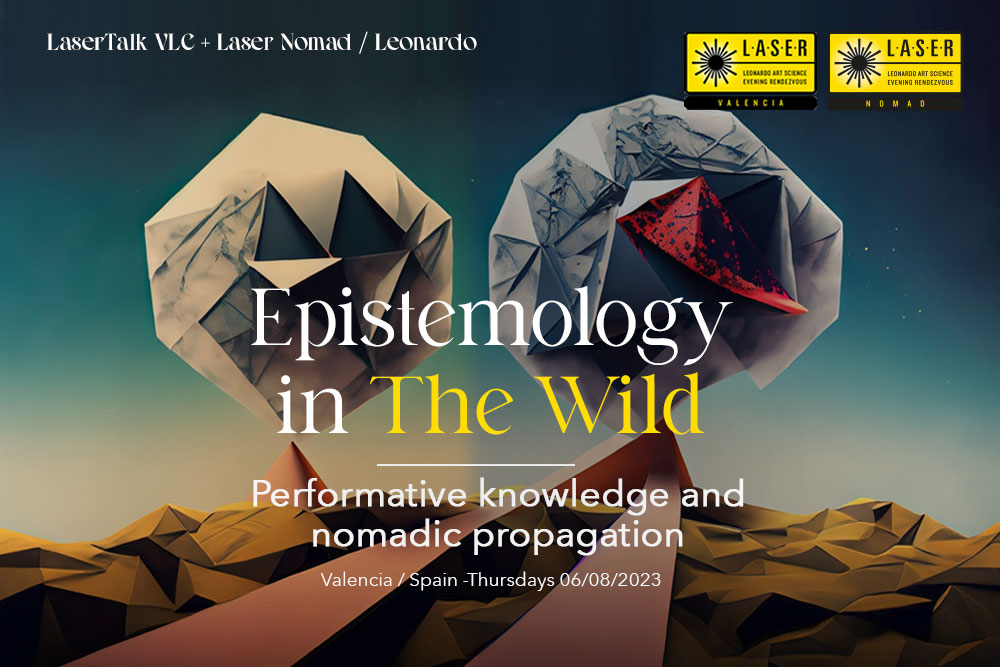
LASER Talks Nomad: Epistemology in The Wild

Photo Credit: AI- Adobe Firefly + Moisés Mañas

In collaboration with LASER VALENCIA

Moderation

Luca Forcucci (LASER NOMAD / ubqtlab.org) + Moisés Mañas (UPV) + Guillermo Muñoz (UV)

Invited Speakers

Paz Tornero + Alberto Conejero

Topics

Ecology of epistemologies, impacts of ‘into the wild’ methodologies

Performance AV / Sonic Rituals

Composition and Performance: Luca Forcucci

Visuals: Paz Tornero + Jorge Dabaliña

Schedule

7pm Moderated discussion

8.30 pm Concert

Location

la fabrica de hielo

C/ de Pavia, 37, 46011 València

Introduction (Spanish below)

Performative knowledge resides in the idea a continuum, an epistemology ‘in the making’, an epistemology of wandering without stable states of equilibrium, leading to nomadic propagation ‘in the wild’. In this discussion, which is as an encounter between two LASER Talks, one NOMAD and the one based in Valencia, we explore why an epistemology ‘in the wild’, namely developed outside controlled environments, brings different results than a framed one. The idea beyond LASER Nomad is a living, developing organism and system. In reference to the term ecosophy by Félix Guattari, the notion is within site-specific situations (environments) according to encounters in specific geographic nodes (social relationships) to develop ideas emerging from the encounters between ancestral cultures and ancestral indigenous epistemology and contemporary ones (human subjectivity). However, it must be underlined that a global system with global solutions is not what is envisioned here; instead, the promotion of an ecosystem of knowledges local and site specific. All knowledge systems are local, including art and sciences. In the current world, many challenges are rapidly appearing and increasing (e.g. environmental issues; the movement of diasporas, authoritarian and retrograde political influences). What is the wild ? Why it may well changes our epistemologies and ontologies ? for who and from whom?

Text: Luca Forcucci 

(Español)

El conocimiento en acción, performativo, se asienta sobre un principio de desplazamiento continuo. Una epistemología “en hacer”, errante y apartada de los estados estables de equilibrio. Una epistemología que viaja de forma nómada propagándose “en lo salvaje”. En el debate que ofrecemos, un encuentro entre dos nodos LASER (Nomad + Valencia) exploramos por qué esa epistemología en estado salvaje, aquella alejada de los entornos controlados, nos proporciona resultados muy distintos de la que permanece fiel a un marco estático. La figura que da forma al proyecto LASER Nomad es la de organismo y sistema vivo en permanente desarrollo. La identidad del proyecto LASER es la multiplicidad forjada mediante la acogida y la diferencia. Usando el término “ecosofía” de Félix Guattari, el principal registro son los ambientes situados [el medio ambiente], para poner en correspondencia a nodos geográficos específicos [relaciones sociales]. Con esta descomposición emergen ideas desde el encuentro entre los saberes y epistemologías ancestrales e indígenas y las defendidas por el norte geográfico [subjetividad humana]. Pero conviene advertir que esta reunión no tratará de construir y edificar un sistema de soluciones globales, sino más bien la promoción de una ecología del conocimiento de programas que siempre serán situados y locales. Todos los sistemas de conocimiento son locales, incluidas las artes y la ciencias. El mundo de hoy queda atravesado por múltiples retos que piden una atención y análisis cada vez a mayor ritmo: el autoritarismo, las diásporas, las crisis climáticas multidimensionales, la vigilancia y la transformación digital, la pérdida de sentido o nuestra relación con la imagen de nuestros futuros, … En este contexto nuestras preguntas son: ¿qué es lo salvaje? ¿por qué “lo salvaje” puede cambiar nuestras epistemologías y ontologías? ¿para quién y por quién?

Texto: Luca Forcucci 

Invited Speakers:

Paz Tornero

Paz Tornero is a Ph.D. in Art, Science and Technocreativity at Complutense University of Madrid. Her thesis is about the relationship between art, science and creativity from 20th century to present and it explores new art forms that incorporate technological and scientific aspects. She has an MA in Fine Arts and Digital Arts from Pompeu Fabra University and a BFA in Fine Arts from Polytechnic University of Valencia. She also studied at Carnegie Mellon University (USA). She was a visiting fellow at Harvard University as well as MIT Media Lab, to expand her knowledge by studying the innovative educational program Idea Translation Lab, led by scientist David Edwards and supported by the Le Laboratoire art center in Paris. Also, visiting researcher at the Massachusetts Institute of Technology (MIT) in its notorious Media Lab center, where she had the honor of being Antoni Muntadas and Krzysztof Wodiczko’s student. She teaches seminars and writes about science, digital art, dance, theatre, humanities, and transdisciplinarity research-learning. Her projects have been showed in international festivals and galleries. She has been artist-in-residence in important programs such as: The Finnish Bioart Society in Finland; a stay on research, ecology and artistic production in the Arctic Circle. Artist-in-Residence for the investigation of transdisciplinary methodologies at the Casa Tres Patios Cultural Foundation in Medellín, Colombia. Or, NIDA SummerSchool for Artistic Research at NIDA Art Colony in Lithuania”. She has been artist-in-residence in ArtScience programs. Currently, she is Associate Professor at the Faculty of Fine Arts, University of Granada in Spain.

Artist and professor expert in theory and practice related to the synergies between Art-Science-Technology. Catching the attention of scientists and collaborating with them in their laboratories is something she is definitely very passionate about. She calls herself the “intruder artist”, which she defines as a visitant-invader of scientific spaces with the goal of understanding their processes and generating new knowledge in between disciplines. 

Alberto Conejero

J. Alberto Conejero has a degree in Mathematics from the Universitat de València (1998) and PhD in Applied Mathematics from the UPV (2004), with the Extraordinary Thesis Award. He also holds a Master’s degree in Bioinformatics and Biostatistics by the Universitat Oberta de Catalunya and the Universitat de Barcelona (2020). He is currently Professor of Applied Mathematics at the Escuela Técnica Superior de Informática (ETSINF) of the UPV. He is also a researcher at the Institute of Pure and Applied Mathematics (IUMPA), director of the Master’s Degree in Mathematical Research, director of the Department of Applied Mathematics and coordinator of department directors at the UPV. Previously, he has held the positions of Vice-Dean of the ETSINF (former Faculty of Computer Science) (2004-2009), Secretary of the Strategic Plan Commission for the period 2007-2014 (2005-2007). Director of the Academic Performance and Curricular Evaluation of Students Curricular Evaluation of Students (2009-2013) and Deputy Secretary General (2013-2016).

He has taught for more than 20 years different mathematics courses: Algebra, Mathematical Analysis, Discrete Mathematics, Graph Theory, Network Science and Data Science Projects in Computer Science and Data Science degrees. He has also taught Biology, Synthetic Biology, Soft Skills, and Art and Science at the UPV. He is the author of two MOOCs in edX, which were awarded by Universia and Telefónica (2013). In addition, he has received the Teaching Excellence Award from the Social Council of the UPV (2014).

His research activity began in the areas of Functional Analysis and Operator Theory in Mathematics, combining it later with interdisciplinary collaborations in various fields.
He is the author of more than 120 research papers published in research journals and international conferences. In addition, he has carried out short stays in the following academic institutions: Bowling Green (OH) and Kent (OH) (USA), Lecce (Italy), Academy of Sciences of Prague (Czech Rep.), and Tübingen (Germany).
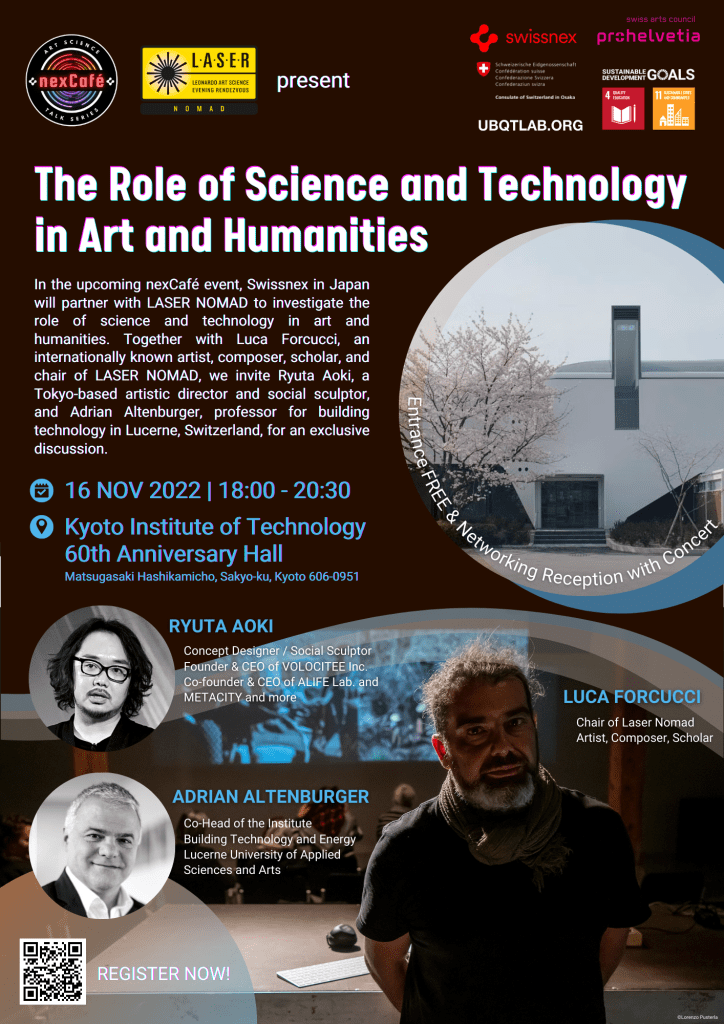
LASER Nomad OSAKA: The Role of Science and Technology in Art and Humanities

In collaboration with nexCafé event, Swissnex in Japan

When

November 16th, 2022 from  6:00 PM to  9:00 PM (Kyoto)

Location

1F, 1 Chome-13-22 Sonezakishinchi, Kita Ward
WeWork Midosuji Frontier
Osaka, 27 530-0002
Japan

What

The first Japanese edition of LASER NOMAD continues its investigation and critic of the implicit biases found in academic publishing, or the disconnect between work within a university and that going on outside, by decompartmentalizing knowledge, namely by creating bridges, and here asking what is the role of science and technology in art and humanities. The quest relates to interdisciplinarity, and indisciplinarity generated by art and science collaborations. Such pervasive fields are now mostly approached from a techno-scientific and Western perspective, and looking outside well established Western academic methodologies, focusing on the rituals involved within such collaboration through a nomad lab as mobile and multi-sited ethnography might lead to new questions and answers.

We investigate the role of science and technology in art and humanities. We invite Ryuta Aoki, a Tokyo-based artistic director and social sculptor, and Adrian Altenburger, professor for building technology in Lucerne, Switzerland, for an exclusive discussion.

18:00-18:10 Welcome and Intro
18:10-19:00 Presentation
19:00-19:20 Discussion
19:20-21:00 Networking Reception with music performance by Luca Forcucci / The Room Above

Who

Ryuta Aoki | 青木竜太

Tokyo-based artistic director and social sculptor. I have been creating invisible structures that maximize people’s creativity to explore the form of “society as it could be” that terraforms cultural deserts into cultural forests. I currently plans, designs, directs and implements research projects, exhibitions, and artworks in the interdisciplinary art and science technology field.

Adrian Altenburger

Professor and Head of Institute / Course Building Technology and Energy at the Lucerne University of Applied Sciences and Arts since 2015. Former partner, board member and co-owner Amstein+Walthert AG from 1999-2015.
Lecturer and adjunct professor in the field of energy and building services engineering in Switzerland and abroad (ETH Zurich, HTW Chur, Harvard University – Graduate School of Design and Harvard University – Extension School, University of Zurich, Kyoto Institute of Technology).

Moderator: Fiammetta Pennisi / Art & Science Swissnex Japan


CHAIRED BY:

Luca Forcucci

A joint LASER: LASER CYLAND and LASER NOMAD present “Inception. Fermentation. Transformations in Sound Art”

Laser CYLAND and Laser NOMAD have decided to collaborate based on the field of possibilities and potentials of collective endeavours.
The term inception suggests a beginning, after the pandemic and other events having brought some lives to an end, the idea of a new start promotes hope. It may also allude to several layers of ideas, dreams or realities. Humanity finds itself in a peculiar situation, movement is certainly more restricted. The issues the world will experience when life goes back to ‘normal’, whatever that may be, and to which kind of normality, are as yet unknown and unknowable. Globality will probably be reconsidered and reshaped. Nevertheless, it seems that we need to continue to dream and reinvent a new future, one that, it is hoped, will avoid dystopian realities.
Transformations in Sound Art and in the Sonic Arts tend to be invisible, but not immaterial.
Fermentation processes may also be used as a modification of matter to create something new in visual, digital, and sound art.

info Link

Where: online

When: Saturday, October 1 at 8PM (Armenian time) (12 PM EST NYC). Find your timezone HERE

Speakers: Luca Forcucci, Sergey Komarov, Katherine Liberovskaya, Phill Niblock


Moderator: Natalia Kolodzei

SPEAKERS BIOS

Luca Forcucci, artist, scholar and guest professor, observes perceptive properties of the first person experience through large scale installations, compositions, video, photography and writing. The research investigates mental imagery of sonic architectures. The works were held at Ars Electronica Linz, Biennale del Mediterraneo Palermo, Museo Reina Sofia Madrid, Centro Hélio Oiticica Rio de Janeiro, The Lab San Francisco, Rockbund Museum Shanghai, MAXXI Rome, or Akademie der Künste Berlin. His plateform UBQTLAB.ORG develops art and science encounters.

Komarov Sergey is a sound artist and curator. In 2003-2005, he curated the Oscillation Works label that published works by experimental musicians. Since 2008, he has worked as a computer programmer and an engineer at CYLAND Media Art Lab; since 2010, he has initiated the Kurvenschreiber Collective. Since 2013, has curated CYFEST International Media Art Festival audio projects and CYLAND Audio Archive (cyland.bandcamp.com(link is external)). Sergey Komarov is a participant of CYFESTs of various years, ArchStoyanie Festival (2014, Kaluga Region, Russia), “The Creative Machine 2” exhibition at Goldsmiths, University of London (2018, UK), exhibitions at Pratt Institute, The National Arts Club, Ca’Foscari University and Experimental Intermedia. 

Katherine Liberovskaya is a Canadian intermedia artist based in New York City. Involved in experimental video since the 80s, she has produced numerous single-channel video art pieces, video installations and video performances, as well as works in other media, that have been shown around the world. Since 2001 her work predominantly focuses on the intersection of moving image with sound/music in various both ephemeral and fixed forms (projections, installations, performances), notably through collaborations with composers and sound artists in improvised live video+sound concert situations where her live visuals seek to create improvisatory “music” for the eyes. In addition to her art work she curates events in experimental video/film, sound/music and A/V performance (primarily Screen Compositions since 2005 and OptoSonic Tea since 2006). In 2014 she completed a PhD in art practice entitled “Improvisatory Live Visuals: Playing Images Like a Musical Instrument” at the Universite du Quebec in Montreal (UQAM). 

Phill Niblock is an intermedia artist using music, film, photography, video and computers. He was born in Indiana in 1933. Since the mid-60’s he has been making music and intermedia performances which have been shown at numerous venues around the world. Since 1985, he has been the director of the Experimental Intermedia Foundation in New York – www.experimentalintermedia.org– where he has been an artist/member since 1968. He is the producer of Music and Intermedia presentations at EI since 1973 and the curator of EI’s XI Records label. Phill Niblock’s music is available on the XI, Moikai, Mode, Matiere Memoire, Room 40, and Touch labels. DVDs of films and music are available on the Extreme label and Von Archive. He is a retired professor of film, video and photography at The College of Staten Island, the City University of New York. In 2014, he was the recipient of the prestigious John Cage Award from the Foundation for Contemporary Arts.

Moderator:
Natalia Kolodzei, an honorary member of the Russian Academy of Arts, is a curator and art historian. Ms. Kolodzei is Executive Director of the Kolodzei Art Foundation (a US-based 501(c)(3) not-for-profit public foundation established in 1991), and, along with Tatiana Kolodzei, owner of the Kolodzei Collection of Eastern European Art, containing over 7,000 artworks (paintings, sculptures, works on paper, photography, kinetic and digital art) by over 300 artists of the 20th and 21st centuries.  Ms. Kolodzei has curated over eighty art exhibitions in the US, Europe and Russia. She is an author and editor of multiple publications and organized and contributed to symposiums and panel discussions for universities and museums worldwide, including co-chair Leonardo Art Science Evening Rendezvous (LASER) CYLAND Talks. In 2010 she was a member of Culture Sub-Working Group under the US-Russia Bilateral Presidential Commission.

Jill Scott: Media Arts, Bodies and Perception

In this interview, Jill Scott and I are sitting in a Ethiopian restaurant in Berlin. We learn about her large body of work spanning from performance, video to sonic arts, media arts and neuroscience. How all this could possibly connect ? A series of travels, experiments and encounters informed this important and very inspiring artist, which are embedded into a unique research in art and science.

Jill Scott / Interview by Luca Forcucci – September 1st 2019 / Berlin

Professor Dr. Jill Scott is an artist, teacher and context provider with 40 years experience in the unique transdisciplinary field of art, science and technology interactions. Her research spans neuroscience, electronics, ecology, sociology, sculpture, performative installation and media art. Her artwork is focused on the human body, the social and physical impact of technology on our bodies and the health of our environment. She asks: How does technological and biotechnical “progress” affect way we “see” our body? How can artists raise awareness about the human body and the scientific structure of sensory perception? How can artists shed light on the health affects of our physical environment? To address these questions, she builds interactive media installations that immerse viewers inside designed environments. She explores how visual metaphors and poetic analogies might create an alternative forms of art and science communication to help others learn more about sensory perception and reflect on their own ideological, biological, ecological, gendered and ethical futures.

 www.jillscott.org