Adrian Sherwood / Interview by Luca Forcucci – April 2025 / Praia – Cape Verde
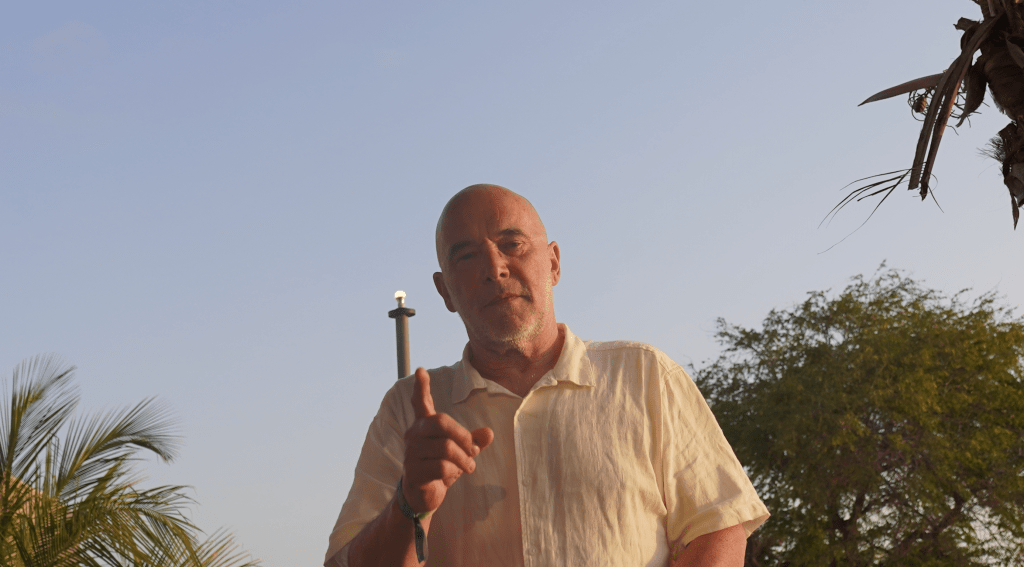
During an afternoon on the Island of Santiago in the city of Praia in Cape Verde, Adrian Sherwood, the legendary music producer responsible for the distinctive sound of the label On-U Sound Records, shared his trajectory and vision of music.
For more than four decades, Adrian Sherwood has been consistently breaking new ground, and has developed a cult-like following via his experiments in dub, reggae, punk, post-punk and bass music. As the founder of the fiercely independent On-U Sound label he has brought the attention of artists like New Age Steppers, Mark Stewart, African Head Charge, Dub Syndicate, Creation Rebel and Tackhead (feat. Doug Wimbish and Skip Macdonald from the original Sugarhill Gang house band) to the world. Unsurprisingly, Adrian has produced and remixed everyone from The Slits to Nine Inch Nails, Depeche Mode to The Fall, Blur to Einsturzende Neubauten, Primal Scream and more.
Perhaps most well-known for his pioneering production work in dub and reggae since the late 1970’s, Adrian’s name draws reverence for his unparalleled work with collaborators such as Prince Far I, Lee Scratch Perry and Mikey Dread.
Sherwood’s output these last few years has been extraordinary; studio albums with Lee Scratch Perry in 2019, “Rainford” and it’s psychedelic dub companion “Heavy Rain”, were seen as a thrilling return to form for Lee, and both albums hit the top of the Billboard Reggae chart. In 2022, Adrian followed up with collaborative albums with Horace Andy – “Midnight Rocker” and it’s sound system counterpart, “Midnight Scorcher”. Midnight Rocker was crowned Guardian’s #1 Global Album of 2022 and was Mojo’s 4th best album of the year. As well as this he released his first album in over a decade with the legendary African Headcharge, ‘A Trip to Bolgatanga’ which unanimous received rave reviews.
In a similar fashion to the oft heralded release ‘Echo Dek’, a rework of Primal Scream’s seminal ‘Vanishing Point’, Sherwood reconstructed indie behemoth Spoon’s latest album – the dubbed out companion, ‘Lucifer on the Moon,’ before attracting the attention of Panda Bear x Sonic Boom, whose collaboration with Sherwood, “Reset in Dub” was released Summer 2023 on Domino Records.
Dub Sessions 2024 Japan with Horace Andy and Creation Rebel concluded successfully with two sold out shows in Tokyo and Osaka. A new digital EP series launched in Summer 2024, highlighting each era of the On-U Sound history.
Plants have inspired movies, countless poetry, or paintings among many others art forms. The realm of plants occupies way more space on earth than humans or any animal presence, and will probably be the last presence on earth when our atmosphere becomes inhabitable and hostile to any life forms.
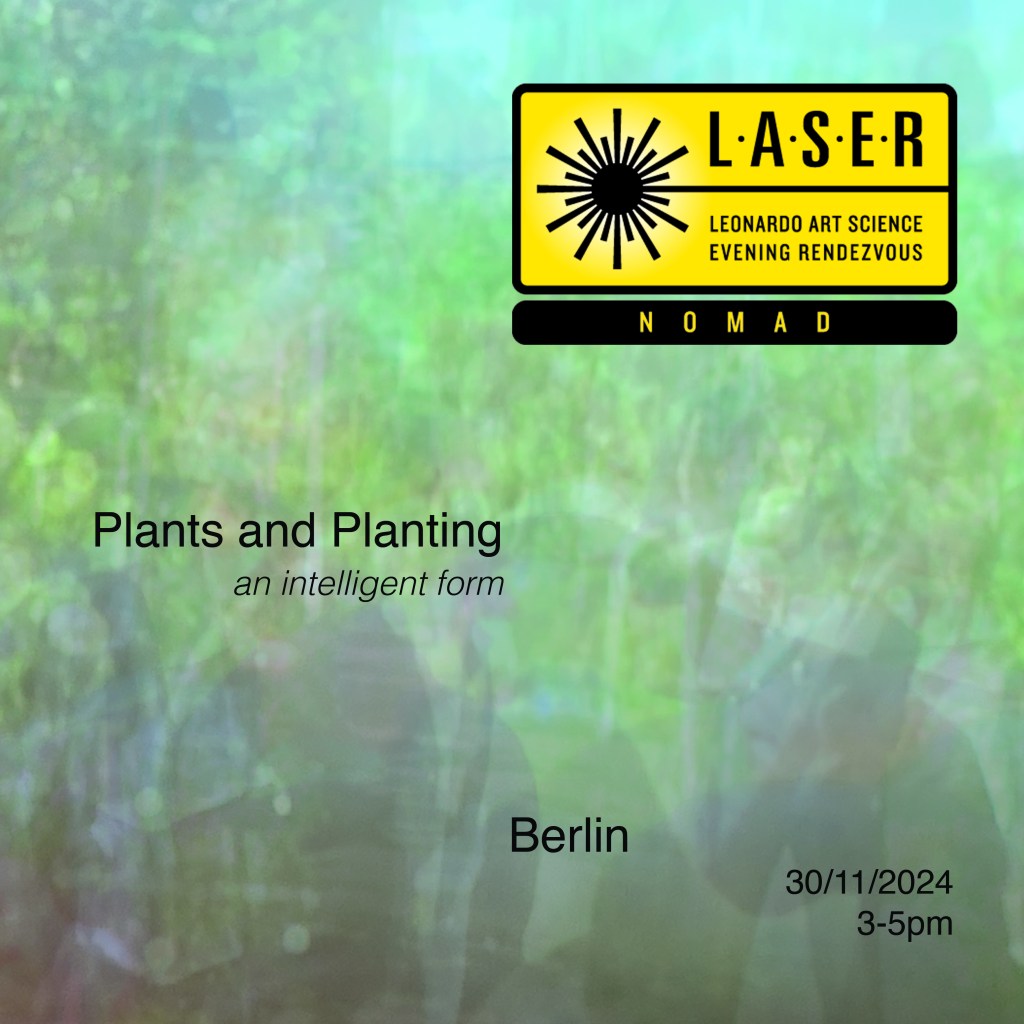
The idea of plant intelligence has generated heated debates, and plant neurobiology has been proposed by Brenner et Al. (1). If intelligence is understood as a capability to adapt to a situation, then plants might be intelligent and thus might not need neurons nor brains. However, in a letter signed by 36 scientists (2), it was claimed that “we begin by stating simply that there is no evidence for structures such as neurons, synapses or a brain in plants.”For this LASER Nomad in Berlin, where it is based, we team with Iopenerart, an organisation operating in the area of ecological behaviour, and with Café Botanico, which focuses on permaculture, gardening techniques and food. We invite an artist, Ana Hupe, and an art critic Maykson Cardoso to address questions about plants, forests and gardens.
References
Alpi, Amedeo et al. 2017. Plant neurobiology: no brain, no gain? Trends in Plant Science, 12 (4): 135-6
Brenner ED, Stahlberg R, Mancuso S, Vivanco J, Baluska F, Van Volkenburgh E. 2006. Plant neurobiology: an integrated view of plant signaling. Trends Plant Science, 11(8):413
Text: Luca Forcucci
Invited Speakers:
Ana Hupe(1983) is visual artist as well as Associate Researcher and Lecturer in Art History at Burg Giebichenstein Kunsthochschule Halle, Germany. She is a doctor in Fine Arts by Federal University of Rio de Janeiro, with a one-year PhD internship at University of the Arts (UdK), Berlin. Hupe’s artistic practice is research-based, process-oriented and often in dialogue with other disciplines and people. Her projects rewrite histories of resistance in installations with plural narratives, attentive to blind spots of representations, building counter-memories to colonial archives. Her work employs a wide range of techniques and media, including lens-based media, writing, printmaking and sculpture.
Tropisms [seclusion, trap or burst], Poetics of Relation and Migratory Movements Consciousness is only possible through change, Change is only possible through movement .- Aldous Huxley, The Art of Seeing
Many tropical plants have fascinating movements with various purposes: defense against herbivores, capturing light or dispersing seeds. Mimosa Pudica, or the Touch-me-not, is one of the best-known moving plants; its leaves react immediately to human touch and close, or fall asleep. Encounters with the power to generate transformative reactions have been described by Édouard Glissant as the Poetics of Relation (1990), a philosophy of encounters and movement, of finding ways to coexist.
Like the restless seeds of the Impatiens Walleriana, which accumulate bit by bit until an external contact–an insect or the wind–make them explode and be thrown far away, this presentation visits vocabularies borrowed from biology to refer to human migratory movements. The terms “invasion”, “native”, “exotic” are some of those that cross the two fields. Migration is more than just a movement derived from necessity, it is a human characteristic. From a bio-inspired perspective, we will reflect at some dynamics of adaptation, resistance and transformations in human societies based on mass migratory movements and how they are framed in public discourses.
Text: Ana Hupe
Maykson Cardoso (Brazil, 1988) is a poet, essayist, art critic and translator, and has previously worked as an independent curator. He is a PhD candidate in Visual Arts/Art History at the Federal University of Rio de Janeiro. His research focuses on Walter Benjamin’s work, approaching it through the motive of archaeology to articulate an “archaeology of violence/Gewalt”.
From Hortus Conclusus to Tropical Forest:Against the Western Notion of Heritage For a Radical Concept of Justice
By analysing pre-Renaissance paintings depicting horti conclusi and other types of medieval walled gardens, we can identify certain elements that expose the Western way of relating to nature. In this presentation, I propose juxtaposing these images with others that represent or document Amazonian Indigenous communities living within the forest. This juxtaposition allows us to evaluate the effects of the clash between these two worldviews, from the invasion of the Americas to contemporary land disputes involving Indigenous peoples, land grabbers, and large landowners in Brazil. The Yanomami shaman Davi Kopenawa refers to non-Indigenous peoples as the “people of merchandise”, thus denouncing the centrality of capitalism in our way of life and our relationship with nature—viewing it solely as a source of extraction for finite natural resources and, consequently, as an “inexhaustible” supply of commodities. Kopenawa’s critique can be linked to the writings of Walter Benjamin, particularly On the Concept of History (1940) and his Notes Toward a Study on the Category of Justice (undated). In the former text, Benjamin fiercely critiques the “ideology of progress” underpinning the political projects of both the left and the right in the West—an ideology still evident in the colonial mindset embodied, for instance, in Brazil’s positivist national motto, “order and progress.” In the latter, Benjamin asserts that “justice is the striving to make the world into the highest good,” proposing a radical inversion of the Western legal paradigm. Rather than basing justice on property rights—which he considers inherently unjust—he advocates for recognising the intrinsic right of the good to belong to itself. By connecting the critiques of Kopenawa and Benjamin, we can envision alternative ways of engaging in politics that are less centred on disputes over property, while also calling into question our notions of heritage, legacy, and justice.
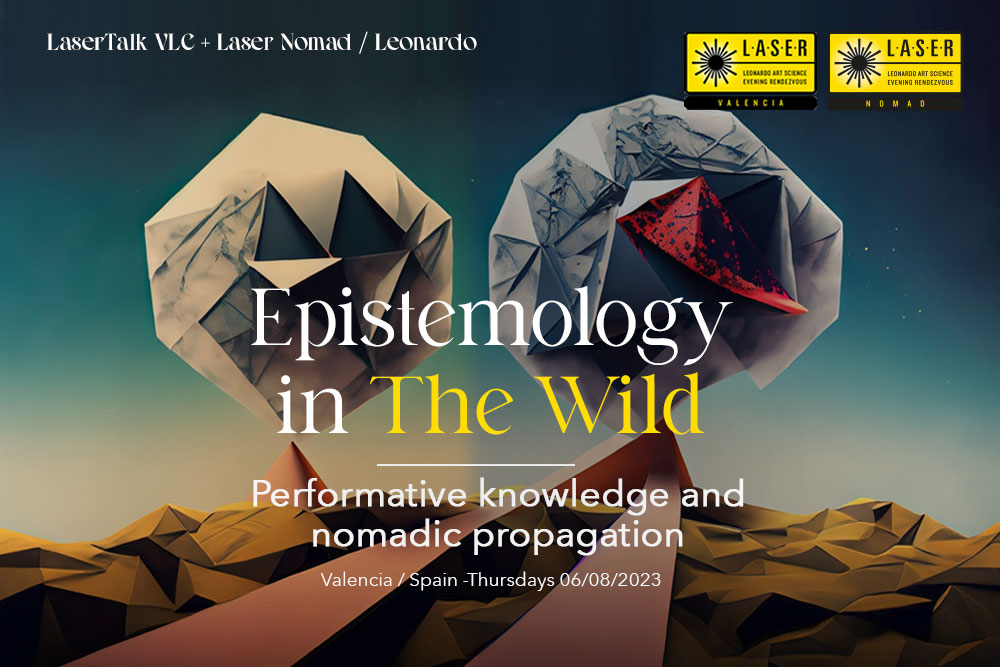
Performative knowledge resides in the idea a continuum, an epistemology ‘in the making’, an epistemology of wandering without stable states of equilibrium, leading to nomadic propagation ‘in the wild’. In this discussion, which is as an encounter between two LASER Talks, one NOMAD and the one based in Valencia, we explore why an epistemology ‘in the wild’, namely developed outside controlled environments, brings different results than a framed one. The idea beyond LASER Nomad is a living, developing organism and system. In reference to the term ecosophy by Félix Guattari, the notion is within site-specific situations (environments) according to encounters in specific geographic nodes (social relationships) to develop ideas emerging from the encounters between ancestral cultures and ancestral indigenous epistemology and contemporary ones (human subjectivity). However, it must be underlined that a global system with global solutions is not what is envisioned here; instead, the promotion of an ecosystem of knowledges local and site specific. All knowledge systems are local, including art and sciences. In the current world, many challenges are rapidly appearing and increasing (e.g. environmental issues; the movement of diasporas, authoritarian and retrograde political influences). What is the wild ? Why it may well changes our epistemologies and ontologies ? for who and from whom?
Text: Luca Forcucci
(Español)
El conocimiento en acción, performativo, se asienta sobre un principio de desplazamiento continuo. Una epistemología “en hacer”, errante y apartada de los estados estables de equilibrio. Una epistemología que viaja de forma nómada propagándose “en lo salvaje”. En el debate que ofrecemos, un encuentro entre dos nodos LASER (Nomad + Valencia) exploramos por qué esa epistemología en estado salvaje, aquella alejada de los entornos controlados, nos proporciona resultados muy distintos de la que permanece fiel a un marco estático. La figura que da forma al proyecto LASER Nomad es la de organismo y sistema vivo en permanente desarrollo. La identidad del proyecto LASER es la multiplicidad forjada mediante la acogida y la diferencia. Usando el término “ecosofía” de Félix Guattari, el principal registro son los ambientes situados [el medio ambiente], para poner en correspondencia a nodos geográficos específicos [relaciones sociales]. Con esta descomposición emergen ideas desde el encuentro entre los saberes y epistemologías ancestrales e indígenas y las defendidas por el norte geográfico [subjetividad humana]. Pero conviene advertir que esta reunión no tratará de construir y edificar un sistema de soluciones globales, sino más bien la promoción de una ecología del conocimiento de programas que siempre serán situados y locales. Todos los sistemas de conocimiento son locales, incluidas las artes y la ciencias. El mundo de hoy queda atravesado por múltiples retos que piden una atención y análisis cada vez a mayor ritmo: el autoritarismo, las diásporas, las crisis climáticas multidimensionales, la vigilancia y la transformación digital, la pérdida de sentido o nuestra relación con la imagen de nuestros futuros, … En este contexto nuestras preguntas son: ¿qué es lo salvaje? ¿por qué “lo salvaje” puede cambiar nuestras epistemologías y ontologías? ¿para quién y por quién?
Paz Tornero is a Ph.D. in Art, Science and Technocreativity at Complutense University of Madrid. Her thesis is about the relationship between art, science and creativity from 20th century to present and it explores new art forms that incorporate technological and scientific aspects. She has an MA in Fine Arts and Digital Arts from Pompeu Fabra University and a BFA in Fine Arts from Polytechnic University of Valencia. She also studied at Carnegie Mellon University (USA). She was a visiting fellow at Harvard University as well as MIT Media Lab, to expand her knowledge by studying the innovative educational program Idea Translation Lab, led by scientist David Edwards and supported by the Le Laboratoire art center in Paris. Also, visiting researcher at the Massachusetts Institute of Technology (MIT) in its notorious Media Lab center, where she had the honor of being Antoni Muntadas and Krzysztof Wodiczko’s student. She teaches seminars and writes about science, digital art, dance, theatre, humanities, and transdisciplinarity research-learning. Her projects have been showed in international festivals and galleries. She has been artist-in-residence in important programs such as: The Finnish Bioart Society in Finland; a stay on research, ecology and artistic production in the Arctic Circle. Artist-in-Residence for the investigation of transdisciplinary methodologies at the Casa Tres Patios Cultural Foundation in Medellín, Colombia. Or, NIDA SummerSchool for Artistic Research at NIDA Art Colony in Lithuania”. She has been artist-in-residence in ArtScience programs. Currently, she is Associate Professor at the Faculty of Fine Arts, University of Granada in Spain.
Artist and professor expert in theory and practice related to the synergies between Art-Science-Technology. Catching the attention of scientists and collaborating with them in their laboratories is something she is definitely very passionate about. She calls herself the “intruder artist”, which she defines as a visitant-invader of scientific spaces with the goal of understanding their processes and generating new knowledge in between disciplines.
J. Alberto Conejero has a degree in Mathematics from the Universitat de València (1998) and PhD in Applied Mathematics from the UPV (2004), with the Extraordinary Thesis Award. He also holds a Master’s degree in Bioinformatics and Biostatistics by the Universitat Oberta de Catalunya and the Universitat de Barcelona (2020). He is currently Professor of Applied Mathematics at the Escuela Técnica Superior de Informática (ETSINF) of the UPV. He is also a researcher at the Institute of Pure and Applied Mathematics (IUMPA), director of the Master’s Degree in Mathematical Research, director of the Department of Applied Mathematics and coordinator of department directors at the UPV. Previously, he has held the positions of Vice-Dean of the ETSINF (former Faculty of Computer Science) (2004-2009), Secretary of the Strategic Plan Commission for the period 2007-2014 (2005-2007). Director of the Academic Performance and Curricular Evaluation of Students Curricular Evaluation of Students (2009-2013) and Deputy Secretary General (2013-2016).
He has taught for more than 20 years different mathematics courses: Algebra, Mathematical Analysis, Discrete Mathematics, Graph Theory, Network Science and Data Science Projects in Computer Science and Data Science degrees. He has also taught Biology, Synthetic Biology, Soft Skills, and Art and Science at the UPV. He is the author of two MOOCs in edX, which were awarded by Universia and Telefónica (2013). In addition, he has received the Teaching Excellence Award from the Social Council of the UPV (2014).
His research activity began in the areas of Functional Analysis and Operator Theory in Mathematics, combining it later with interdisciplinary collaborations in various fields. He is the author of more than 120 research papers published in research journals and international conferences. In addition, he has carried out short stays in the following academic institutions: Bowling Green (OH) and Kent (OH) (USA), Lecce (Italy), Academy of Sciences of Prague (Czech Rep.), and Tübingen (Germany).
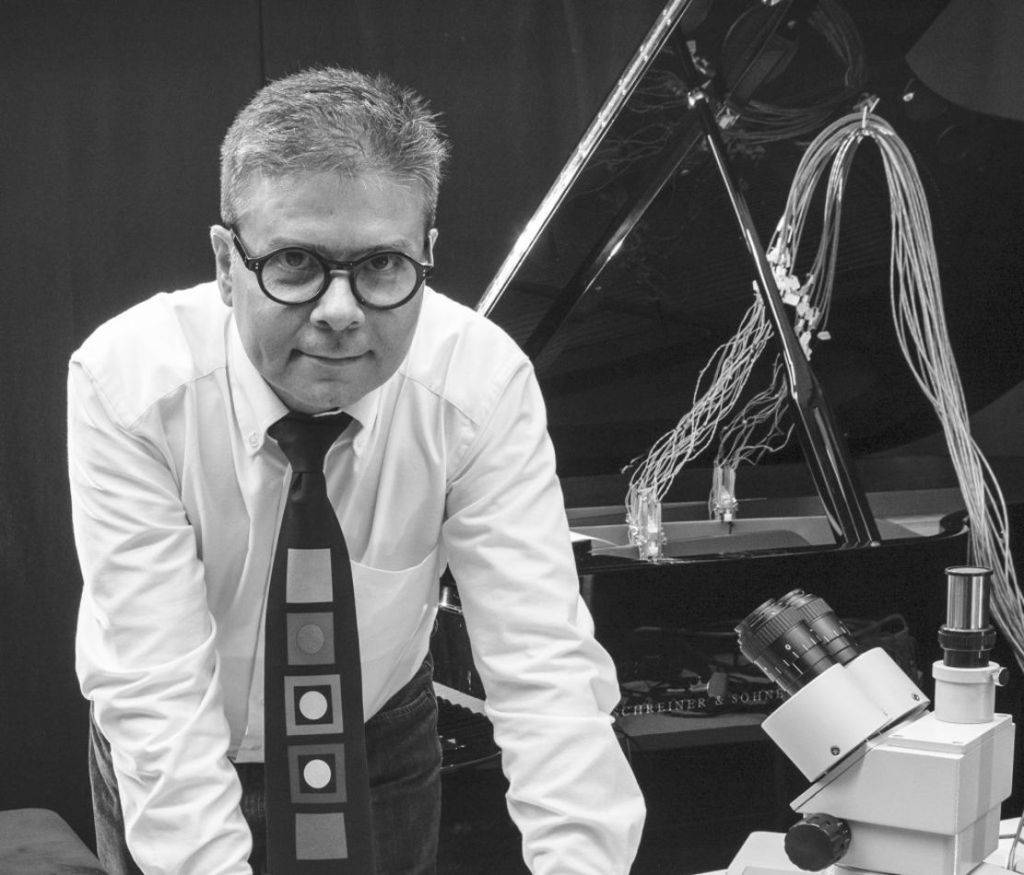
The mystery of the music in the brain is far from being understood. Through his career and while exploring brain music interfaces, quantum computing, cognition and biocomputers, Eduardo Reck Miranda take us into a field of possibilities for the future (of) music. Unlocking new opportunities and crossing boundaries of medical science and arts, we here discuss why music technology offers (again) new perspectives for music composition.
Eduardo Reck Miranda / Interview by Luca Forcucci – January 2023 / Berlin
Eduardo Reck Miranda’s distinctive music is informed by his unique background as an Artificial Intelligence (AI) scientist and classically trained composer. He is internationally known for his research in neurotechnology for music and is championing investigation into quantum computing for musical creativity. Eduardo was a research scientist in the evolution of language group at Sony CSL Paris. He is a professor at the University of Plymouth, UK, where he leads the Interdisciplinary Centre for Computer Music Research (ICCMR). Currently, he is working with Quantinuum to develop applications of quantum computing in music. His opera ‘Lampedusa’, composed with sonification of subatomic particle collisions and live-electronics was premiered by BBC Singers.
New paper, just out of the oven: In 2015, after having successfully passed my PhD, I was invited for an art & science residency named Scientific Delirium, Madness (!!!) in the Silicon Valley, by the Djerassi Foundation and Leonardo / ISATS. I spent one month in a beautiful landscape with the Pacific ocean on the horizon, and with very talented artists and scientists (13). During that time, I worked on a composition involving the body of a dancer as the sonic source, a sculpture inside a tree with a sculptor, and I developed the initial ideas for my very own lab, www.ubqtlab.org. Since then, the project, LASER NOMAD, has traveled over four continents. I finished a paper about the story of this project that can be find here, and it will be published later on print.
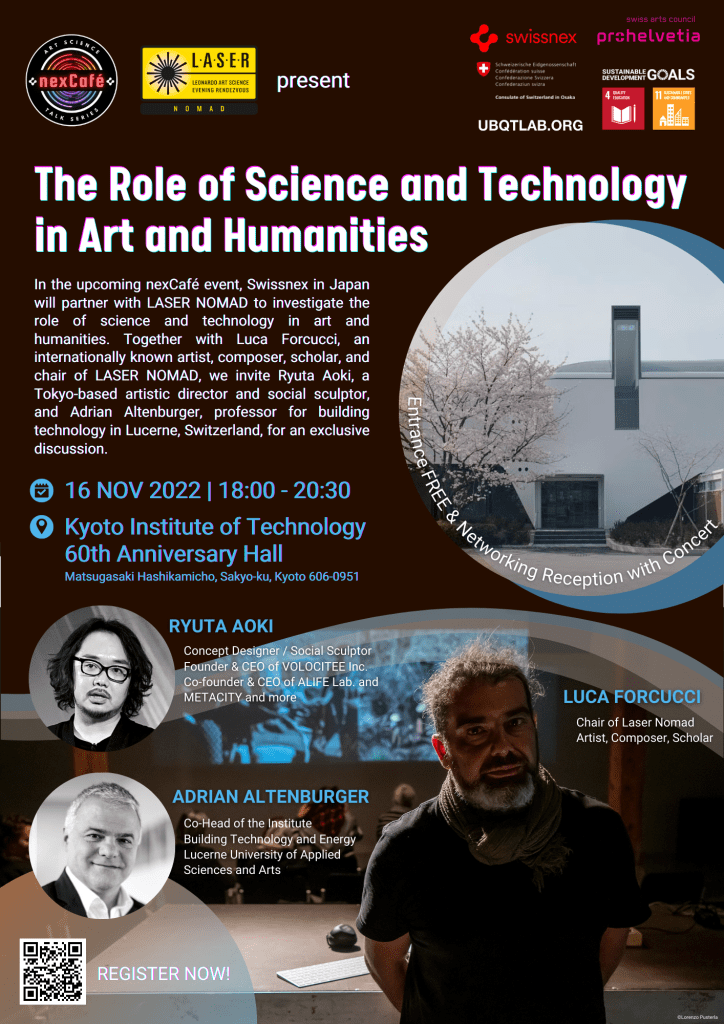
In collaboration with nexCafé event, Swissnex in Japan
When
November 16th, 2022 from 6:00 PM to 9:00 PM (Kyoto)
Location
1F, 1 Chome-13-22 Sonezakishinchi, Kita Ward WeWork Midosuji Frontier Osaka, 27 530-0002 Japan
What
The first Japanese edition of LASER NOMAD continues its investigation and critic of the implicit biases found in academic publishing, or the disconnect between work within a university and that going on outside, by decompartmentalizing knowledge, namely by creating bridges, and here asking what is the role of science and technology in art and humanities. The quest relates to interdisciplinarity, and indisciplinarity generated by art and science collaborations. Such pervasive fields are now mostly approached from a techno-scientific and Western perspective, and looking outside well established Western academic methodologies, focusing on the rituals involved within such collaboration through a nomad lab as mobile and multi-sited ethnography might lead to new questions and answers.
We investigate the role of science and technology in art and humanities. We invite Ryuta Aoki, a Tokyo-based artistic director and social sculptor, and Adrian Altenburger, professor for building technology in Lucerne, Switzerland, for an exclusive discussion.
18:00-18:10 Welcome and Intro 18:10-19:00 Presentation 19:00-19:20 Discussion 19:20-21:00 Networking Reception with music performance by Luca Forcucci / The Room Above
Tokyo-based artistic director and social sculptor. I have been creating invisible structures that maximize people’s creativity to explore the form of “society as it could be” that terraforms cultural deserts into cultural forests. I currently plans, designs, directs and implements research projects, exhibitions, and artworks in the interdisciplinary art and science technology field.
Professor and Head of Institute / Course Building Technology and Energy at the Lucerne University of Applied Sciences and Arts since 2015. Former partner, board member and co-owner Amstein+Walthert AG from 1999-2015. Lecturer and adjunct professor in the field of energy and building services engineering in Switzerland and abroad (ETH Zurich, HTW Chur, Harvard University – Graduate School of Design and Harvard University – Extension School, University of Zurich, Kyoto Institute of Technology).
Laser CYLAND and Laser NOMAD have decided to collaborate based on the field of possibilities and potentials of collective endeavours. The term inception suggests a beginning, after the pandemic and other events having brought some lives to an end, the idea of a new start promotes hope. It may also allude to several layers of ideas, dreams or realities. Humanity finds itself in a peculiar situation, movement is certainly more restricted. The issues the world will experience when life goes back to ‘normal’, whatever that may be, and to which kind of normality, are as yet unknown and unknowable. Globality will probably be reconsidered and reshaped. Nevertheless, it seems that we need to continue to dream and reinvent a new future, one that, it is hoped, will avoid dystopian realities. Transformations in Sound Art and in the Sonic Arts tend to be invisible, but not immaterial. Fermentation processes may also be used as a modification of matter to create something new in visual, digital, and sound art.
Luca Forcucci, artist, scholar and guest professor, observes perceptive properties of the first person experience through large scale installations, compositions, video, photography and writing. The research investigates mental imagery of sonic architectures. The works were held at Ars Electronica Linz, Biennale del Mediterraneo Palermo, Museo Reina Sofia Madrid, Centro Hélio Oiticica Rio de Janeiro, The Lab San Francisco, Rockbund Museum Shanghai, MAXXI Rome, or Akademie der Künste Berlin. His plateform UBQTLAB.ORG develops art and science encounters.
Komarov Sergeyis a sound artist and curator. In 2003-2005, he curated the Oscillation Works label that published works by experimental musicians. Since 2008, he has worked as a computer programmer and an engineer at CYLAND Media Art Lab; since 2010, he has initiated the Kurvenschreiber Collective. Since 2013, has curated CYFEST International Media Art Festival audio projects and CYLAND Audio Archive (cyland.bandcamp.com(link is external)). Sergey Komarov is a participant of CYFESTs of various years, ArchStoyanie Festival (2014, Kaluga Region, Russia), “The Creative Machine 2” exhibition at Goldsmiths, University of London (2018, UK), exhibitions at Pratt Institute, The National Arts Club, Ca’Foscari University and Experimental Intermedia.
Katherine Liberovskaya is a Canadian intermedia artist based in New York City. Involved in experimental video since the 80s, she has produced numerous single-channel video art pieces, video installations and video performances, as well as works in other media, that have been shown around the world. Since 2001 her work predominantly focuses on the intersection of moving image with sound/music in various both ephemeral and fixed forms (projections, installations, performances), notably through collaborations with composers and sound artists in improvised live video+sound concert situations where her live visuals seek to create improvisatory “music” for the eyes. In addition to her art work she curates events in experimental video/film, sound/music and A/V performance (primarily Screen Compositions since 2005 and OptoSonic Tea since 2006). In 2014 she completed a PhD in art practice entitled “Improvisatory Live Visuals: Playing Images Like a Musical Instrument” at the Universite du Quebec in Montreal (UQAM).
Phill Niblockis an intermedia artist using music, film, photography, video and computers. He was born in Indiana in 1933. Since the mid-60’s he has been making music and intermedia performances which have been shown at numerous venues around the world. Since 1985, he has been the director of the Experimental Intermedia Foundation in New York – www.experimentalintermedia.org– where he has been an artist/member since 1968. He is the producer of Music and Intermedia presentations at EI since 1973 and the curator of EI’s XI Records label. Phill Niblock’s music is available on the XI, Moikai, Mode, Matiere Memoire, Room 40, and Touch labels. DVDs of films and music are available on the Extreme label and Von Archive. He is a retired professor of film, video and photography at The College of Staten Island, the City University of New York. In 2014, he was the recipient of the prestigious John Cage Award from the Foundation for Contemporary Arts.
Moderator: Natalia Kolodzei, an honorary member of the Russian Academy of Arts, is a curator and art historian. Ms. Kolodzei is Executive Director of the Kolodzei Art Foundation (a US-based 501(c)(3) not-for-profit public foundation established in 1991), and, along with Tatiana Kolodzei, owner of the Kolodzei Collection of Eastern European Art, containing over 7,000 artworks (paintings, sculptures, works on paper, photography, kinetic and digital art) by over 300 artists of the 20th and 21st centuries. Ms. Kolodzei has curated over eighty art exhibitions in the US, Europe and Russia. She is an author and editor of multiple publications and organized and contributed to symposiums and panel discussions for universities and museums worldwide, including co-chair Leonardo Art Science Evening Rendezvous (LASER) CYLAND Talks. In 2010 she was a member of Culture Sub-Working Group under the US-Russia Bilateral Presidential Commission.
The journey takes us from the 1980’s USA to Japan and 1990’s Berlin. Music stories emerges from Merzbow, Zbigniew Karkowski and ear plugs, Amsterdam squats, Aphex Twin’s influence to the great tradition of counterpoint reborn as disco in Germany. How shared technology and evolution of music relates to culture ? What it means spatializing music and inclusivity in The CUBE at Virginia Tech with a festival created around Afrofuturism and immersive music ? As a composer Eric Lyon talks about pushing the boundaries further and interstices in music, like for example composing for a violin duo, with String Noise, accidents in the process and nuclear wars, random encounters, rewriting the Bad Brains’ music and the intemporal in the arts.
Eric Lyon / Interview by Luca Forcucci – May 2022 / Berlin – Blacksburg / Part 1Eric Lyon/ Interview by Luca Forcucci – May 2022 / Berlin – Blacksburg / Part 2
Eric Lyon is a composer and audio researcher focused on digital interventions, post-hierarchies, high-density loudspeaker arrays, and the inspiration of performer-based creativity. His publicly released audio software includes “FFTease” and “LyonPotpourri.” He is the author of “Designing Audio Objects for Max/MSP and Pd,” a guidebook for writing audio DSP code for live performance. In 2015-16, Lyon architected both the Spatial Music Workshop and Cube Fest at Virginia Tech to support the work of other artists working with high-density loudspeaker arrays. Lyon’s creative work has been recognized with a ZKM Giga-Hertz prize, MUSLAB award, the League ISCM World Music Days competition, and a Guggenheim Fellowship. Lyon teaches in the School of Performing Arts at Virginia Tech, and is a Faculty Fellow at the Institute for Creativity, Arts, and Technology.
——————————————————
SUPPORT
As a non profit project promoting knowledge and education, any support helps to provide new content and develop future ideas. Thanks
France Jobin has a long career in experimental music. She introduces her works as related to the sonic and architecture, and how she developed works inspired and informed by quantum physics, including the challenges induced by art and science collaborations
France Jobin / Interview by Luca Forcucci – November 2021 / Berlin – MontréalPicture : Bruno Destombes Photographe
Biography
“This album seems to mark a shifting in Jobin’s sound, one that departs from the strictly ultra-minimal ethos she’s known for, and I for one am excited to hear where this goes.
Darren McClure Intrication, No. Toneshift (December 2018)
“We detect imperceptible subsurface discolourations, brief dissipations of energy across the harmonic flawlessness, a few dynamic weaknesses and slight distortions in an otherwise rather narcotic flux. It’s sorrow-inducing, brain-quietening, and profoundly individual.
Massimo Ricci Death is perfection, everything else is relative EMEGO 276 Touching Extremes (July 2020)
France Jobin is a sound / installation / artist, composer and curator residing in Montreal, Canada. Her audio art can be qualified as “sound-sculpture”, revealing a minimalist approach to complex sound environments where analog and digital intersect. Her installations express a parallel path, incorporating both musical and visual elements inspired by the architecture of physical spaces. Her works can be “experienced” in a variety of unconventional spaces and new technology festivals across Canada, the United States, South America, South Africa, Europe, Australia, Japan and South Corea. Since 2009, her focus has been related to Quantum mechanics. Many of her projects are inspired by theories related to topics such as vacuum decay, string theory and more recently, what she feels to be the most perplexing phenomenon in the world of the quantum , entanglement resulting in a first presentation, Entanglement A/V, with visual artist Markus Heckmann, which delves into the realms of quantum physics premiered at Mutek Mtl 2021.
In November 2019, she presented her first modular concert (Buchla 100) at the Ernst Krenek Institute in Austria. Jobin has created solo recordings for Editions Mego(AT), No-ware (CL-DE), Silent Records (USA), popmuzik records (JP), bake/ staalplaat (NL), ROOM40 (AU), nvo (AT), DER (US), ATAK (JP), murmur records (JP), Baskaru (FR) and the prestigious LINE label (US). Jobin’s sound art is also part of countless compilation albums, notably on the ATAK (JP), bremsstrahlung (US), Mutek (CA), murmur records (JP), and/oar (US), tsuku boshi (FR), everest records (CH), and Contour Editions (US) labels. She is also featured in the influential book and recording, Extract, Portraits of Soundartists (book + 2 cd), released on the nonvisualobjects label (AT). The collaborative album ligne, created with sound artist Tomas Phillips, was released on the ATAK label (JP) and her recent collaboration with acclaimed artist Richard Chartier, DUO, is released on the mAtter label in Japan.
DUO A/V premiered at Mutek Mtl 2019 with sound artist Richard Chartier and visual artist Markus Heckmann and was presented at the Precxte festival in South Corea. Her installations and screenings have been shown internationally at museums and festivals. Her work P Orbital released on LINE (Valence, LINE054) was presented in the context of ESCUCHAS, a first sound art exhibit for the Museum of Modern Art in Medellin, Colombia. P Orbital was also presented at CONTEXT-ing / Listening as CONTEXT at the Miami Art Fair in Florida, Call &Response, London Uk as well as at the Haunted formalism exhibit in LA curated by Volume. An invitation to the AIR Artist-In-Residence program in Krems, Austria enabled her to create und transit, a sound installation set in the MinoritenKirche cloister in Stein (AT) and und transit.03 has been presented in the sound art exhibit “Dock” at the Ancien Palais de Justice in Lièges, Belgium.
Her two ongoing collaborations with visual artist Cédrick Eymenier (FR) have resulted in EVENT HORIZON, an audio/video piece, and The Answer, a movie, with the soundtrack by France Jobin and Stephan Mathieu. EVENT HORIZON was screened in Paris (2010), at the Venezuela Biennale in Merida state (2010) and was performed live at the Torrance Art Museum in Los Angeles (2010) and ISEA RUHR 2010 (DE). The Answer was screened at IAC, Villeurbanne, France in March – May 2016. In 2011, Jobin was one of five international artists selected to present her sound installation, Entre-Deux, in the new media exhibit Data/Fields, curated by Richard Chartier at Artisphere in the Washington, DC area, along with Ryoji Ikeda, Mark Fell, Caleb Coppock, and Andy Graydon. Her proposition received critical acclaim from the national press. Entre-Deux was presented at N38E13 in Palermo, Sicily (2017). She premiered the audio visual performance of “intrication” at Mutek AR 2018 with the Argentinian visual duo prifma. Her audio visual collaboration: “Mirror Neurons” with sound artist Fabio Perletta (IT) and xx+xy visuals (IT) was screened as a world premiere at A x S / ak-sis / FESTIVAL 2014 | CURIOSITY as part of the Synergetica Screening in Los Angeles in September 2014. In October 2015, France was invited to take part in an artist residency at EMPAC (Troy,NY) which resulted in the creation of a new light sound work entitled 4.35 – R0 – 413, a collaboration with Alena Samoray, lighting designer.
Her latest installations, ‘Inter/sperse’ and ‘Entre/temps’ both premiered in Italy. ‘Inter/sperse’ is a site specific installation created in the context of an international residency organized by Museolaboratorio, LUX and farmacia901. It opened May 27 2017 at Museolaboratorio, Città Sant’Angelo Italy. ‘Entre/temps’ is a site specific installation commissioned by Enzo De Leonibus, artistic director of the EaRrEtMeI festival which opened in Palena, Itally, June 4 2017.
She has also participated in numerous music and new technology festivals such as Mutek (Montreal, 2001, 2004 – 2009, 2014, 2017, 2019 AR 2018), Festival Novas Frequencies (Rio, Brazil, 2019) Prectxe (South Korea, 2019), Interference (Austin, 2019), Suoni Per Il Popolo (Montreal 2019), EM15 (Montreal 2014), EMPAC (US 2011, 2015), roBOT 8 (Italy 2015) Angelica Festival (Italy 2016), Portobeseno (Italy 2014), Interferenze – Liminaria (Italy 2014), Flussi Media Arts Festival (Italy 2014), FIMAV, SEND + RECEIVE (Winnipeg, 2003, 2005), Club Transmediale (Berlin, 2004), Shut up and Listen (Vienna, 2009), ISEA RUHR 2010 (Germany), the surface tension tour (Japan, 2012) and the Symétrie tour (Japan 2016).
“immersound” is a concert event/philosophy concept initiated by Jobin, which proposes the creation of a dedicated listening environment by focusing on the physical comfort of the audience within a specifically designed space. The premise of “immersound” is to seek out/explore new perceptions in and experiences of the listening process by pushing the notion of “immersion” to its possible limits. She created and produced “immersound” from 2011 to 2015 at Oboro in Montreal.
She was a finalist at the Sonic Arts Awards 2014 (IT) in the Sonic Research category. In January 2013, the Conseil québécois de la musique (CQM) awarded the prestigious Opus Prize for Concert of the year to France Jobin for her concert at AKOUSMA 8.
Jobin’s work continues to evolve as technologies enable her to create new environments. France Jobin is published by Touch Music/Fairwood Music UK Ltd




 u(bqt)lab