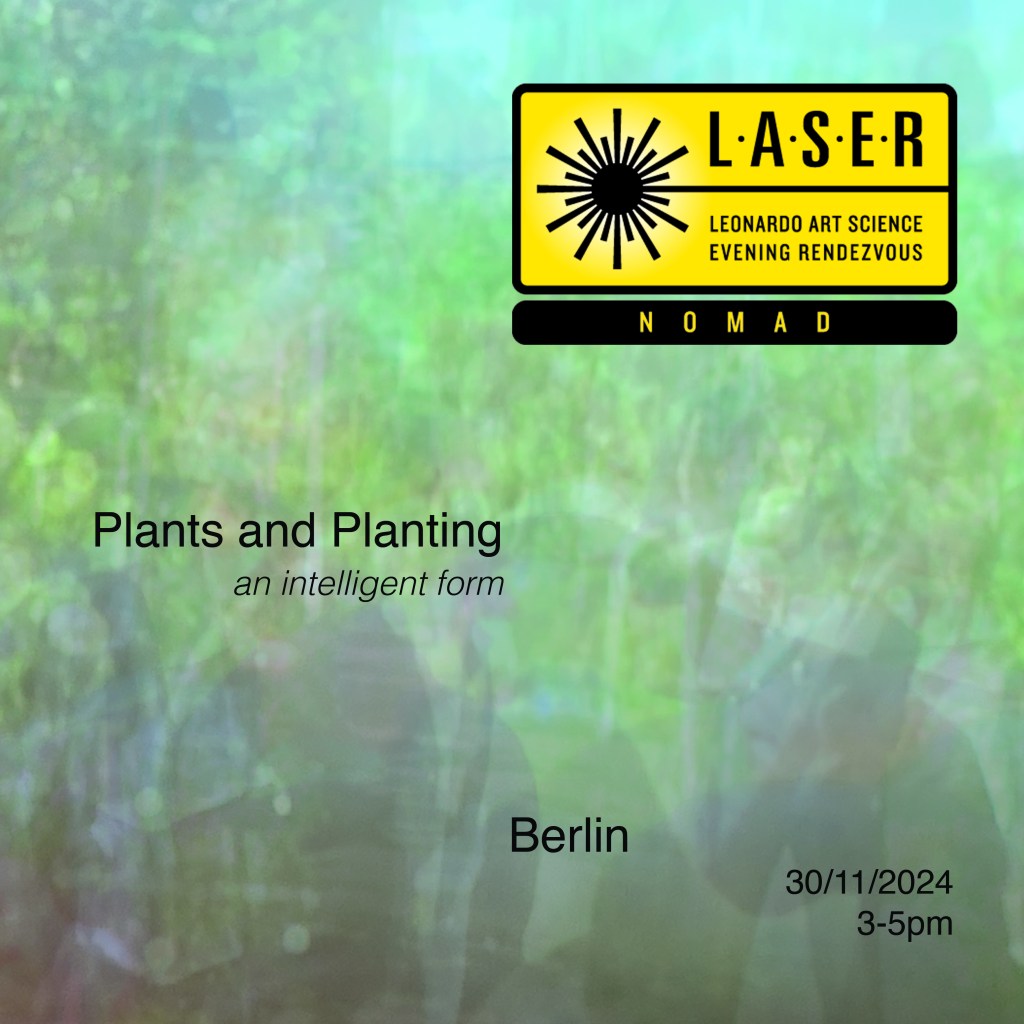
Photo Credit: Luca Forcucci
RSRV uqbt at gmai dot com
In collaboration with IOPENER AND CAFé BOTANICO
Moderation
Luca Forcucci (LASER NOMAD / ubqtlab.org) + Oliver Juan (Iopener)
Invited Speakers
Ana Hupe + Maykson Cardoso
Topics
Plants and Forest Intelligence
Schedule
3/5pm Moderated discussion
Location
Richardstraße 100, 12043 Berlin
Introduction
Plants have inspired movies, countless poetry, or paintings among many others art forms. The realm of plants occupies way more space on earth than humans or any animal presence, and will probably be the last presence on earth when our atmosphere becomes inhabitable and hostile to any life forms.
The idea of plant intelligence has generated heated debates, and plant neurobiology has been proposed by Brenner et Al. (1). If intelligence is understood as a capability to adapt to a situation, then plants might be intelligent and thus might not need neurons nor brains. However, in a letter signed by 36 scientists (2), it was claimed that “we begin by stating simply that there is no evidence for structures such as neurons, synapses or a brain in plants.”For this LASER Nomad in Berlin, where it is based, we team with Iopenerart, an organisation operating in the area of ecological behaviour, and with Café Botanico, which focuses on permaculture, gardening techniques and food. We invite an artist, Ana Hupe, and an art critic Maykson Cardoso to address questions about plants, forests and gardens.
References
Alpi, Amedeo et al. 2017. Plant neurobiology: no brain, no gain? Trends in Plant Science, 12 (4): 135-6
Brenner ED, Stahlberg R, Mancuso S, Vivanco J, Baluska F, Van Volkenburgh E. 2006. Plant neurobiology: an integrated view of plant signaling. Trends Plant Science, 11(8):413
Text: Luca Forcucci
Invited Speakers:
Ana Hupe (1983) is visual artist as well as Associate Researcher and Lecturer in Art History at Burg Giebichenstein Kunsthochschule Halle, Germany. She is a doctor in Fine Arts by Federal University of Rio de Janeiro, with a one-year PhD internship at University of the Arts (UdK), Berlin. Hupe’s artistic practice is research-based, process-oriented and often in dialogue with other disciplines and people. Her projects rewrite histories of resistance in installations with plural narratives, attentive to blind spots of representations, building counter-memories to colonial archives. Her work employs a wide range of techniques and media, including lens-based media, writing, printmaking and sculpture.
Tropisms [seclusion, trap or burst], Poetics of Relation and Migratory Movements
Consciousness is only possible through change,
Change is only possible through movement .-
Aldous Huxley, The Art of Seeing
Many tropical plants have fascinating movements with various purposes: defense against herbivores, capturing light or dispersing seeds. Mimosa Pudica, or the Touch-me-not, is one of the best-known moving plants; its leaves react immediately to human touch and close, or fall asleep. Encounters with the power to generate transformative reactions have been described by Édouard Glissant as the Poetics of Relation (1990), a philosophy of encounters and movement, of finding ways to coexist.
Like the restless seeds of the Impatiens Walleriana, which accumulate bit by bit until an external contact–an insect or the wind–make them explode and be thrown far away, this presentation visits vocabularies borrowed from biology to refer to human migratory movements. The terms “invasion”, “native”, “exotic” are some of those that cross the two fields. Migration is more than just a movement derived from necessity, it is a human characteristic. From a bio-inspired perspective, we will reflect at some dynamics of adaptation, resistance and transformations in human societies based on mass migratory movements and how they are framed in public discourses.
Text: Ana Hupe
Maykson Cardoso (Brazil, 1988) is a poet, essayist, art critic and translator, and has previously worked as an independent curator. He is a PhD candidate in Visual Arts/Art History at the Federal University of Rio de Janeiro. His research focuses on Walter Benjamin’s work, approaching it through the motive of archaeology to articulate an “archaeology of violence/Gewalt”.
From Hortus Conclusus to Tropical Forest:Against the Western Notion of Heritage For a Radical Concept of Justice
By analysing pre-Renaissance paintings depicting horti conclusi and other types of medieval walled gardens, we can identify certain elements that expose the Western way of relating to nature. In this presentation, I propose juxtaposing these images with others that represent or document Amazonian Indigenous communities living within the forest. This juxtaposition allows us to evaluate the effects of the clash between these two worldviews, from the invasion of the Americas to contemporary land disputes involving Indigenous peoples, land grabbers, and large landowners in Brazil. The Yanomami shaman Davi Kopenawa refers to non-Indigenous peoples as the “people of merchandise”, thus denouncing the centrality of capitalism in our way of life and our relationship with nature—viewing it solely as a source of extraction for finite natural resources and, consequently, as an “inexhaustible” supply of commodities. Kopenawa’s critique can be linked to the writings of Walter Benjamin, particularly On the Concept of History (1940) and his Notes Toward a Study on the Category of Justice (undated). In the former text, Benjamin fiercely critiques the “ideology of progress” underpinning the political projects of both the left and the right in the West—an ideology still evident in the colonial mindset embodied, for instance, in Brazil’s positivist national motto, “order and progress.” In the latter, Benjamin asserts that “justice is the striving to make the world into the highest good,” proposing a radical inversion of the Western legal paradigm. Rather than basing justice on property rights—which he considers inherently unjust—he advocates for recognising the intrinsic right of the good to belong to itself. By connecting the critiques of Kopenawa and Benjamin, we can envision alternative ways of engaging in politics that are less centred on disputes over property, while also calling into question our notions of heritage, legacy, and justice.
Text: Maykson Cardoso
Partners


 u(bqt)lab